
Sometimes decisions can be difficult. We feel stuck between our options, or we might not know what we want, or we feel overwhelmed with the task of choosing. All of this can add to our stress and make our situation(s) more difficult to handle.
This is where the Pro-Con Tool comes in. It’s a tool that can help clarify what is important to you and help you reach a satisfactory choice when it comes to making a decision.
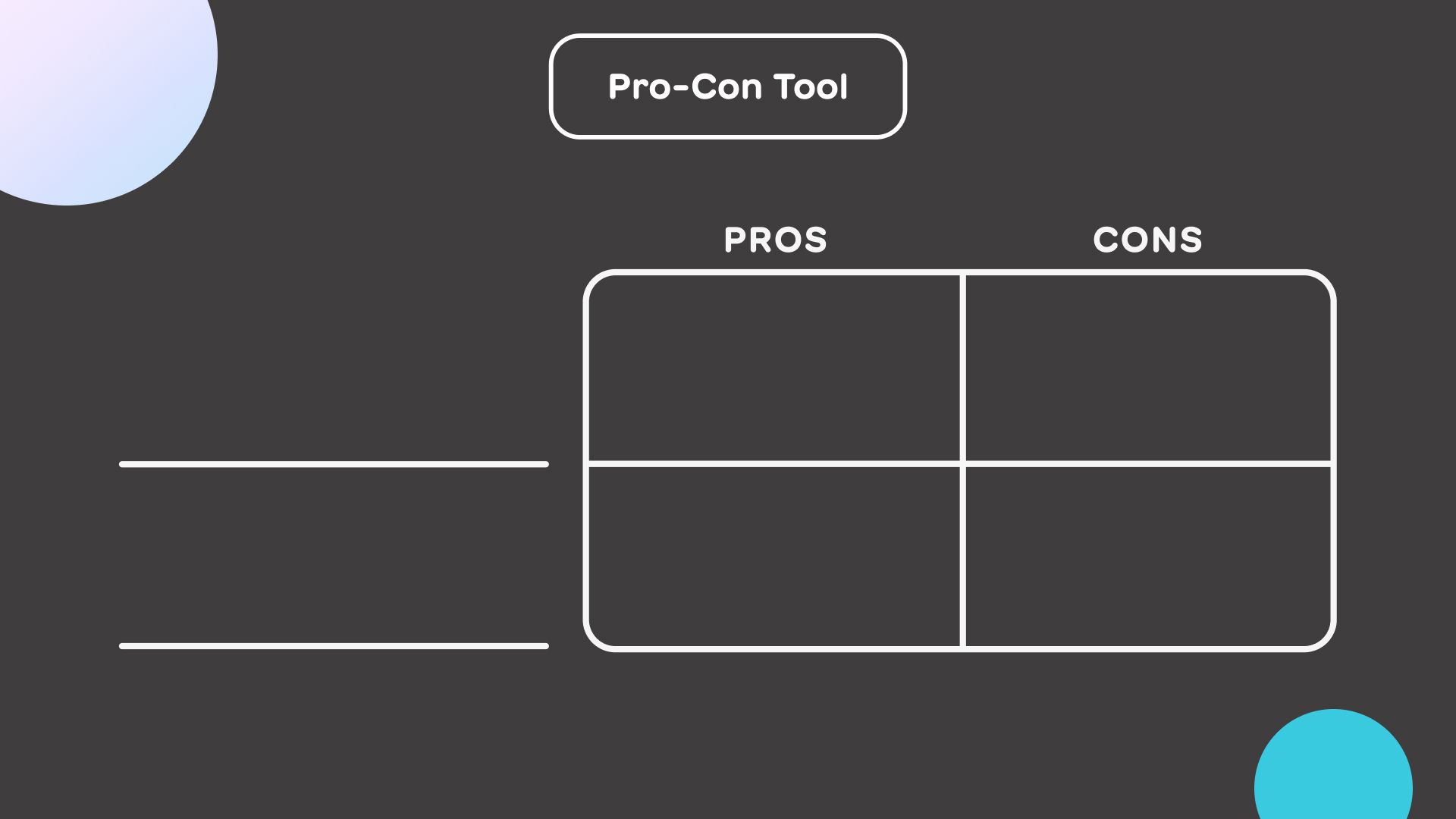
In the featured image above, you’ll see a square divided in to four equal sections, with the left column labeled “Pros” and the right column labeled “Cons.” To the left, each row has a space to add the ideas or decisions you’re trying to compare. Here’s how to use the tool:
- Write in the two ideas or options you’re comparing in the two lines on the left. These two ideas or options should negate one another. For example, you might weigh Going to a Social Event vs. Not Going to a Social Event.
- For each idea or option, write a “pro” in its respective pro box and a “con” in its respective con box. Don’t worry if some of the answers in different boxes address the same idea, just answer as fully and genuinely as you can.

Once you’ve finished your list, it’s time to use the results. Instead of having them bounce around in your head, you now have a clear set of pros and cons laid out in front of you to compare. This will allow you to assess the outcomes of your decision more clearly and weigh the factors that come with your choice.
If you prefer a more analytical approach, try the following: take a look at each point you wrote out and assign it a positive or negative value according to how important it is to you. Use positive values for your pro list and negative items for your cons list. For example, an item in your pros list that is very important to you might be weighted (+5) and an item in your cons list that is very important to you would be weighted (-5).
Time for some quick math. Add up the values in each of the four boxes. Your pro boxes should have positive numbers and your cons boxes should have negative numbers. Now you can compare your two ideas more rationally:
- Does Going to a Social Event have more pros with a higher rating than Not Going to a Social Event?
- Does Not Going to a Social Event have more cons with a higher rating than Going to a Social Event?
- Or you might notice, “Wow, it looks like I really value the pros that would come from Going to a Social Event over the pros I have for Not Going to a Social Event.”
What if your numbers are tied? You might consider taking another look at your list or asking someone to help you analyze your list a bit further.
There’s also a chance you feel uncertain about your scores. Maybe there’s an outcome you preferred that didn’t end up as your “logical” choice. It could be that your gut is telling you something—you already know which choice you want to make, even if it isn’t the “best” on paper. Remember, this tool is simply a tool. You always have the ability to choose what feels right to you.
Download a worksheet version of the Pro-Con tool to use on your own:
Leave a Reply